The Rising Importance of Cryptocurrency Tokens in the AI Era
The convergence of artificial intelligence and blockchain technology is reshaping our digital landscape in profound ways. As AI systems become increasingly sophisticated and integrated into our daily lives, cryptocurrency tokens are emerging as critical infrastructure for this new technological paradigm. Far from being separate innovations, AI and crypto tokens are becoming deeply intertwined, creating new possibilities for how we build, access, and benefit from intelligent systems.
Decentralizing AI Access and Ownership
One of the most significant challenges facing the AI industry today is the concentration of power and resources. Training and running advanced AI models requires enormous computational resources, often accessible only to well-funded tech giants. Cryptocurrency tokens are helping to democratize this landscape by enabling decentralized AI networks where computational power can be shared, traded, and compensated through token-based systems.
Projects leveraging tokens allow individuals to contribute their computing resources to train or run AI models in exchange for token rewards. This creates a more distributed infrastructure that reduces dependence on centralized cloud providers and makes AI development more accessible to researchers and startups with limited budgets.
Enabling Fair Compensation for Data Contributors
AI models are only as good as the data they're trained on, yet the people who generate this valuable data—through their online activities, creative work, and interactions—rarely see any compensation. Cryptocurrency tokens offer a solution to this fundamental inequity.
Token-based systems can create marketplaces where individuals are directly rewarded for contributing quality training data. Whether it's labeled images, text samples, or specialized domain knowledge, tokens provide a transparent and efficient mechanism for compensating data providers. This not only creates fairer economic models but also incentivizes the creation of higher-quality, more diverse datasets that can improve AI performance.
Transparent Governance and Decision-Making
As AI systems make increasingly important decisions affecting people's lives, questions about governance and accountability become crucial. Who decides how an AI model should behave? What values should it reflect? Cryptocurrency tokens, particularly governance tokens, provide a mechanism for distributed decision-making about AI systems.
Token holders can vote on critical parameters like model training objectives, ethical guidelines, content moderation policies, and feature development priorities. This creates more democratic oversight of AI systems compared to traditional corporate structures where a small group of executives makes all the decisions. While this approach has its own challenges, it represents an important experiment in aligning AI development with broader community values.
Facilitating AI Agent Economies
Perhaps the most futuristic application of cryptocurrency tokens in the AI era is in enabling autonomous AI agents to participate in economic transactions. As AI agents become more capable of performing tasks independently—from scheduling meetings to negotiating contracts—they need a way to conduct financial transactions without human intervention.
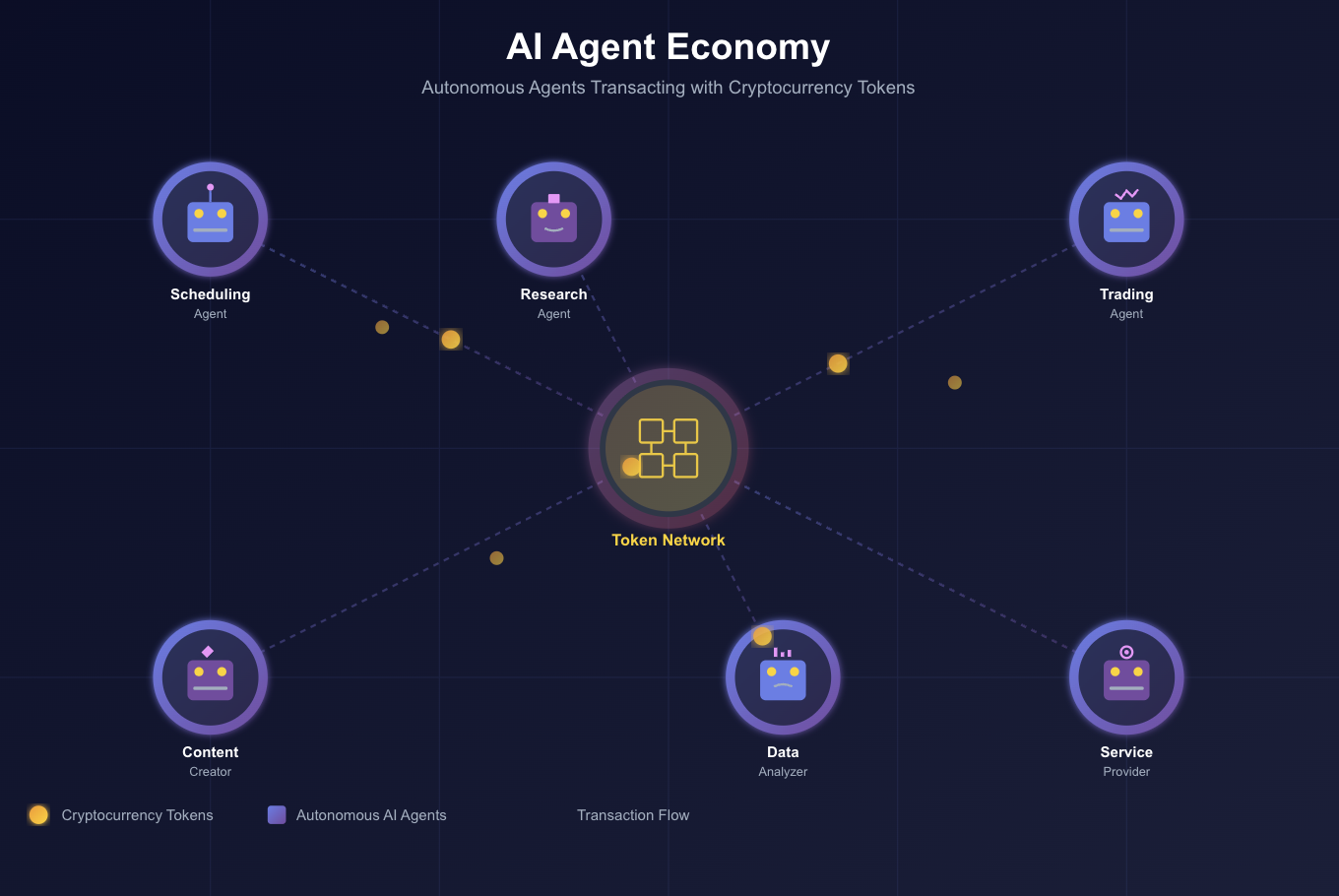
Cryptocurrency tokens provide the perfect medium for these machine-to-machine economies. AI agents can hold token wallets, pay for services, receive compensation for completed work, and engage in complex multi-party transactions—all without requiring traditional banking infrastructure or human approval for each transaction. This could unleash entirely new categories of automated services and economic activity.
Verifying AI-Generated Content and Authenticity
In an era where AI can generate increasingly convincing text, images, and videos, distinguishing authentic content from AI-generated material becomes critical. Blockchain technology and tokens can help create verifiable provenance chains for digital content.
Tokens can be used to certify content authenticity, timestamp creation, track modifications, and prove human authorship when necessary. This becomes especially important for combating misinformation, protecting intellectual property rights, and maintaining trust in digital media. Content creators can tokenize their work, creating unforgeable records of originality that persist even as AI-generated content proliferates.
Incentivizing Open Source AI Development
The AI field has benefited enormously from open source contributions, but sustaining these efforts financially remains challenging. Token-based incentive systems offer new models for funding open source AI development.
Projects can issue tokens that reward contributors for code commits, model improvements, documentation, and community support. As the project grows in value and adoption, early contributors benefit from token appreciation, creating sustainable funding mechanisms that don't depend solely on corporate sponsorship or donations. This could accelerate the development of open alternatives to proprietary AI systems.
Challenges and Considerations
While the potential is significant, the integration of cryptocurrency tokens into AI systems isn't without challenges. Regulatory uncertainty around both AI and cryptocurrencies creates legal complexities. The volatility of token values can make compensation unpredictable. Energy consumption concerns affect both AI training and certain blockchain networks. And there are valid questions about whether adding token economics improves AI systems or simply adds unnecessary complexity.
Moreover, not every AI application benefits from tokenization. The key is identifying use cases where tokens genuinely solve problems around incentive alignment, resource distribution, or governance that would be difficult to address through traditional means.
Looking Forward
As we move deeper into the AI era, cryptocurrency tokens are likely to play an increasingly important role in shaping how AI systems are built, deployed, and governed. They offer tools for creating more equitable, transparent, and distributed AI ecosystems that could serve as counterweights to centralized control.
The most successful applications will likely be those that use tokens to solve genuine coordination problems rather than those that add blockchain technology simply because it's trendy. When thoughtfully implemented, token-based systems can align incentives among diverse stakeholders, enable new forms of collaboration, and create more robust and fair AI infrastructure.
The intersection of AI and cryptocurrency represents one of the most interesting experimental spaces in technology today. As both fields continue to evolve rapidly, their synthesis may produce innovations we can barely imagine—new economic models, governance structures, and forms of human-machine collaboration that reshape our relationship with intelligent systems. Whether you're an AI researcher, blockchain developer, or simply someone interested in the future of technology, this convergence is worth watching closely.